


Thanks to Dr. Paul Marik and the IMA, the word is getting out that Cancer Stem Cells are the roots of cancer and must be blocked to avoid cancer recurrence. It no longer is enough to simply remove the cancer with surgery, then zap it with radiation and chemotherapy, and forget about it.
Because Cancer Stem Cells have a nasty tendency to regrow the entire tumor and spread it all over the body in resistant form months or years later. And then it is often too late.
Block Cancer Stem Cells Early & Often
Dr. Marik and I have written about the urgency of blocking CSCs early and often. And with the strongest CSC blockers. We recently published on the rise in Turbo Cancers and mentioned the ROOT4™ Protocol which can pre-emptively suppress the main CSC pathways. We believe use of this protocol can help prevent Turbo Cancers from developing in high-risk patients.
The ROOT™ Protocols
The components of the ROOT4™ protocol include EGCG, Curcumin, Omega 3, and Vitamin D. When combined they suppress all of the 7 major Cancer Stem Cell growth pathways.
AI estimates that the ROOT4™ protocol can prevent the formation of the most common cancers by about 50%. However, with the addition of more agents, we have also developed the ROOT6™ and ROOT9™ Protocols which AI estimates can more effectively prevent these cancers. AI estimates that the ROOT9™ protocol can prevent the formation of the most common cancers by nearly 90%.
The CSC pathways blocked in the ROOT™ Protocols include WNT, Notch, Hedgehog, STAT3, JAKSTAT, NF-kB, and TGF beta. By adding additional agents with CSC blocking properties, one can theoretically prevent cancer with even greater efficacy.
The Ongoing Search for Newer and Better CSC Blockers
Naturally Dr. Marik and I are constantly searching the literature for more studies on repurposed drugs or agents that block key CSC pathways. We prioritize those agents that not only have preclinical evidence but also have clinical studies behind them.
Today I bring you such an agent.
An Unknown CSC Blocker Comes to Light
AI ranks this new CSC blocker as more powerful than many of the blockers we have mentioned in the ROOT™ protocols, even more powerful than Vitamin D, EGCG, Quercetin, Sulforaphane, and Resveratrol.
After finding it, I rechecked the AI results with a different model, and the rankings and findings were similar. I verified the studies, both clinical and preclinical. And they held up.
This New Anti-CSC Agent Blocks All 7 Major Cancer Stem Cell Pathways by Itself
This previously unknown agent blocks not just a few CSC pathways, but all the major ones. It is a ROOT™ Protocol unto itself and can be used as a standalone agent or in combination with other CSC blockers.
Naturally the studies reflect its powerful ability to not only suppress cancer pathways but its potential to treat cancer as well.
I was particularly impressed with its ability to block WNT, the main driver of colon cancer metastases. I feel strongly it should be added at the first diagnosis of colon cancer, and certainly before metastatic disease develops, but more on this later.
In Addition to CSC Blocking, this Agent Helps Reverse the Warburg Effect
Thanks to the fine work of The Leading-Edge Clinic with Dr. Pierre Kory and Scott Marsland, my readers all know about the Warburg Effect and the Metabolic Model of Cancer.
We realize the evidence no longer supports the Somatic Mutation Model but instead is much more aligned with defective mitochondria as the cause of cancer. As Otto Warburg first found and won a Nobel Prize for this in 1931, Dr. Thomas Seyfried has further developed the Metabolic Model of Cancer.
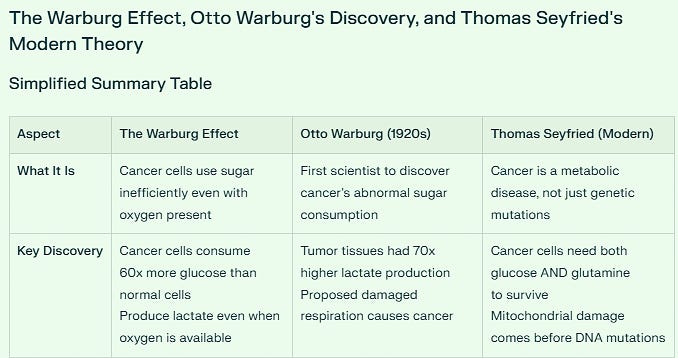

The mainstream Oncology Community continues to treat cancer as though it were a genetic disease, one where mutations accumulate until cancer forms. However, the evidence is that genetic mutations are not the cause. Transplanting cancerous cell nuclei into normal cells fails to replicate cancers.
However, transplanting cancerous mitochondria into normal cells does replicate cancer. Cancer is a disease of the mitochondria and when mitochondria are damaged through various conditions, they tend to resort to fermentation in the presence of oxygen, the Warburg Effect.
As Dr. Thomas Seyfried has found through extensive research, this is the common denominator for all cancers. If one could reverse the Warburg Effect consistently and reliably, one could cure cancer.
And our new agent reverses Warburg.
And yes, I will reveal soon not only the agent, but the patent that a team of researchers has filed on a version of this agent. This patent improves the bioavailability of the agent by up to 80% making it more effective against a greater number of cancers.
This Agent has Potential Against 30 Different Cancers
However, in its current basic version, it is already a powerful suppressor of hematologic cancer. It is most effective against leukemias and myeloma.
Here is the breakdown of its effectiveness against the various cancers by Tiers.
This agent, in my opinion, is a must - immediately - for anyone who wishes to either prevent or treat cancer.
Promise in 30 Different Cancer Types Supported by Many Clinical & Preclinical Trials
Tier 1: Clinical Validation (High Efficacy + Clinical Trials) - 4 Cancers
1. Acute Myeloid Leukemia (AML)
Development Stage: Phase I Clinical Trials
IC50: 0.05-0.22 μM (highest sensitivity)
Key Evidence: LSC population reduction, survival benefit in xenografts
2. Prostate Cancer
Development Stage: Phase I/II Clinical Trials
IC50: 0.60-0.62 μM
Key Evidence: PSA responses in 5/8 patients, ARv7 targeting
3. Colorectal/Colon Cancer
Development Stage: Phase I/II Clinical Trials
IC50: 0.37-1.25 μM
Key Evidence: Liver metastasis reduction, ongoing trials
4. Breast Cancer
Development Stage: Preclinical + Clinical Trials
IC50: 0.24-1.05 μM
Key Evidence: Metastases reduction, MDSC suppression
Tier 2: High Potential (Strong Preclinical Evidence) - 10 Cancers
Outstanding Candidates Include:
Multiple Myeloma: IC50 0.05-1.0 μM - Most sensitive solid tumor
Glioblastoma/Brain Cancer: IC50 0.29-2.25 μM - CSC frequency reduction
Lung Cancer (NSCLC): IC50 0.16-0.96 μM - Radiation sensitization
Ovarian Cancer: IC50 0.35-1.01 μM - MEK/ERK inhibition
Neuroblastoma: IC50 0.5-2.0 μM - Differentiation therapy enhancement
Tier 3: Moderate Potential - 15 Cancers
Includes T-ALL, hepatocellular carcinoma, esophageal cancer, osteosarcoma, melanoma, and various other solid tumors with IC50 values typically 1.0-2.0 μM.
Most Sensitive Cancer Types (Lowest IC50 Values)
Top 6 Most Sensitive:
RPMI-8226 (Multiple Myeloma): 0.05 μM
HL-60 (AML): 0.14 μM
NCI-H460 (Lung): 0.16 μM
K562 (CML): 0.18 μM
UACC-62 (Melanoma): 0.22 μM
MDA-MB-468 (Breast): 0.24 μM
Key Mechanistic Patterns
Multi-Pathway Targeting Enables Broad Efficacy
WNT/β-catenin: Primary target in colorectal, breast, prostate cancers
STAT3: Critical in hematologic malignancies and solid tumors
NF-κB: Important in inflammatory cancers and metastasis
Mitochondrial disruption: Universal metabolic mechanism
Cancer Stem Cell Advantage
Unique CSC targeting in:
Glioblastoma (reduces multipotent cell frequency)
Ovarian cancer (blocks tumor-initiating cells)
Breast cancer (targets stem-like subpopulations)
Neuroblastoma (reverses differentiation resistance)
Clinical Translation Priorities
Immediate Clinical Candidates (Next 2-5 Years)
Multiple Myeloma: Exceptional sensitivity (IC50 0.05 μM)
Glioblastoma: Unmet medical need, strong CSC targeting
Lung Cancer: Excellent combination potential
Ovarian Cancer: Strong preclinical efficacy
Combination Therapy Opportunities
Glioblastoma: Temozolomide synergy
Lung Cancer: Erlotinib combination
Renal Cell Carcinoma: Sorafenib synergy
Prostate Cancer: Enzalutamide combination
Strategic Insights
Hematologic Malignancy Advantage: Blood cancers show the highest sensitivity, with IC50 values often below 0.5 μM, making them priority targets.
Pan-Cancer Therapeutic Potential: The ability to target 30+ different cancer types through multi-pathway inhibition positions this agent as one of the most versatile anticancer agents ever identified.
Cancer Stem Cell Focus: Unique CSC targeting capability provides advantages in treatment-resistant and metastatic cancers where traditional therapies often fail.
Clinical Validation Pipeline: With 5 cancer types currently in clinical trials and 14 high-efficacy candidates identified, this agent represents a robust pipeline for multiple cancer indications.
The comprehensive evidence supports this compound as a broad-spectrum anticancer agent with exceptional potential across diverse tumor types.
Introducing this Crucial Agent - Blocks all 7 CSC Pathways - Helps Reverse the Warburg Effect - Creates a Paradigm Shift in Cancer Treatment
Here are the cancers that this repurposed agent can help treat immediately - based on the established clinical trial data.
And I will provide cost and availability as well. The average price for a one-month supply is estimated at 10 to 12 dollars.
Glioblastoma (with temozolomide combination)
Breast Cancer
Ovarian Cancer
Neuroblastoma (pediatric-derived dosing)
Prostate Cancer
Lung Cancer (NSCLC)
Pancreatic Cancer
Multiple Myeloma
AML [Acute Myelogenous Leukemia]
Colorectal Cancer
Included is a Dosing Schedule for Each of the Above Listed Cancers
And now, allow me to introduce to you what may be the most important repurposed cancer drug to date.