
Why Starving Cancer Doesn't (Usually) Work
The Major Reason Our Metabolic Repurposed Treatments Fail


The Invisible Fortress: How Desmoplasia and Hypoxia Conspire to Create Untreatable Cancers and How We Can Break the Shield
When we think of cancer, we often imagine rapidly dividing rogue cells, relentlessly multiplying until they overwhelm the body. These cells consume fuel from various sources, including glucose via the Warburg Effect. At times, these tumors adapt to use other sources including glutamine. Starving the tumor of nutrients might seem appealing, but in practice often fails.
This image, of cancer cells rapidly multiplying, and consuming fuel through aerobic glycolysis, however appealing, represents only a fraction of the reality in the vast majority of solid tumors. In the world of clinical oncology, the true driver of treatment failure and patient mortality is rarely the metabolizing cancer cell in isolation.
Instead, it is the fortress that the cancer cell builds around itself.
Recent data indicates that roughly 75 to 80 percent of all solid malignant cancers globally—equating to nearly 14.8 million out of 18.5 million annual diagnoses—are heavily driven by a cooperative microenvironmental defense system. This system relies on two distinct but deeply intertwined forces: a dense physical wall of scar-like tissue known as a desmoplastic shield, and a suffocating lack of oxygen known as hypoxia.
Roughly 75% to 80% of all solid malignant cancers globally are heavily driven or structurally maintained by either systemic hypoxia (hif-1 alpha stabilization), a dense protective structural wall (desmoplastic shields), or a highly cooperative combination of both microenvironmental pressures. [1, 2, 3]
In clinical oncology, these two structural phenomena represent a unified resistance mechanism: heavy mechanical desmoplasia collapses local capillary structures, cutting off blood perfusion, which in turn acts as the primary physical catalyst stabilizing hypoxia-inducible factor expression. [1, 3]
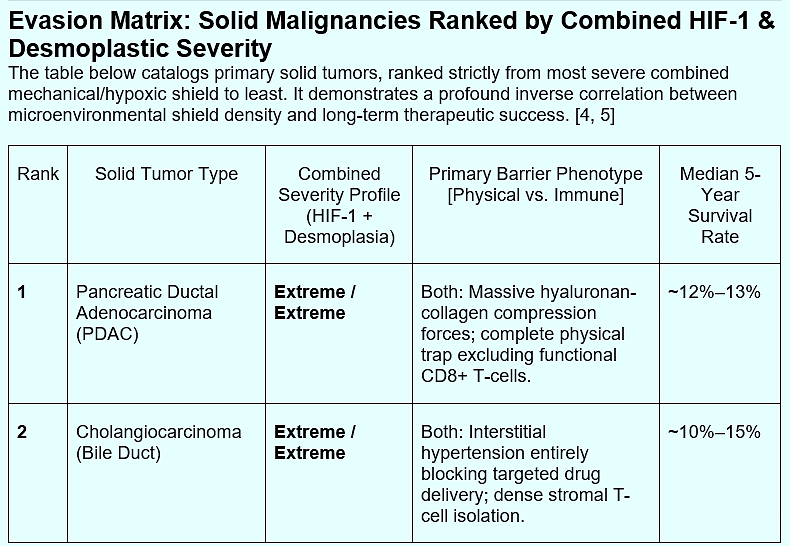
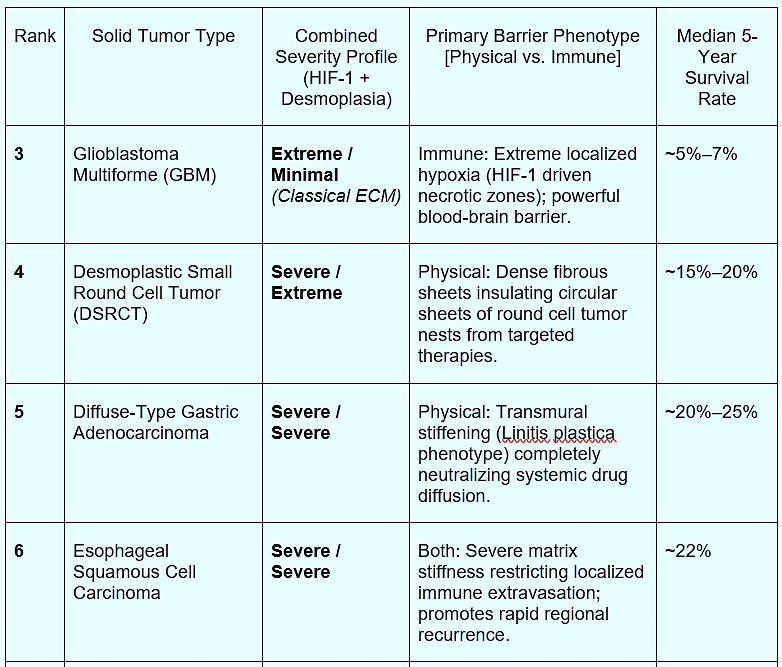
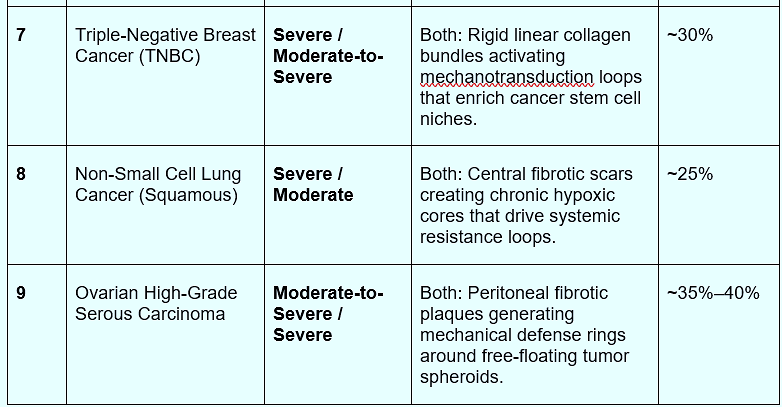
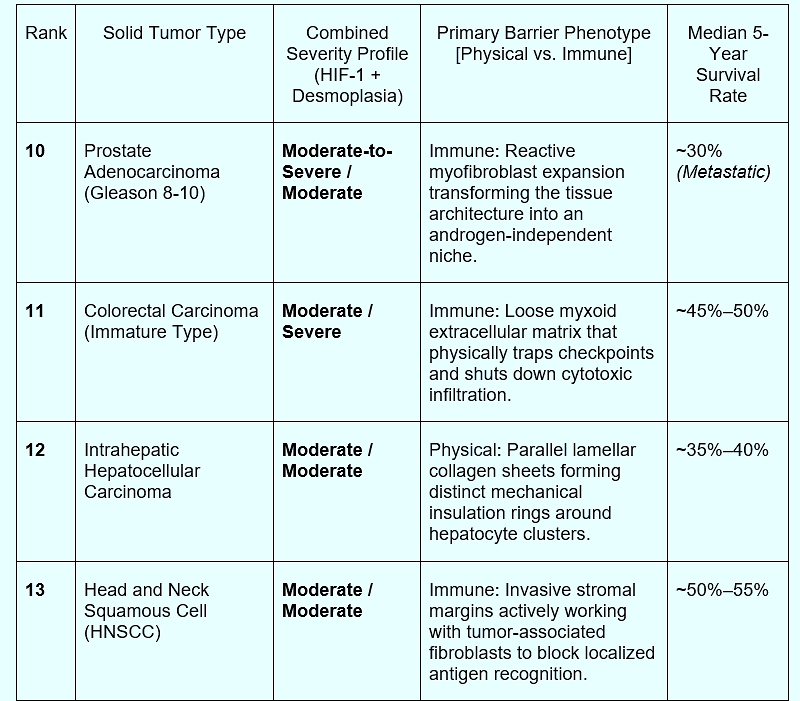
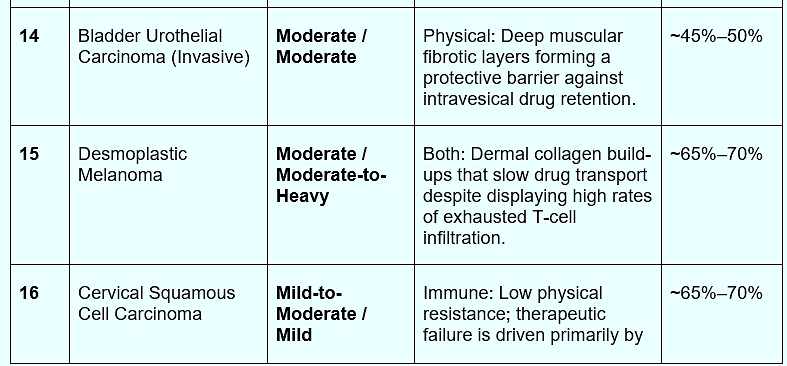
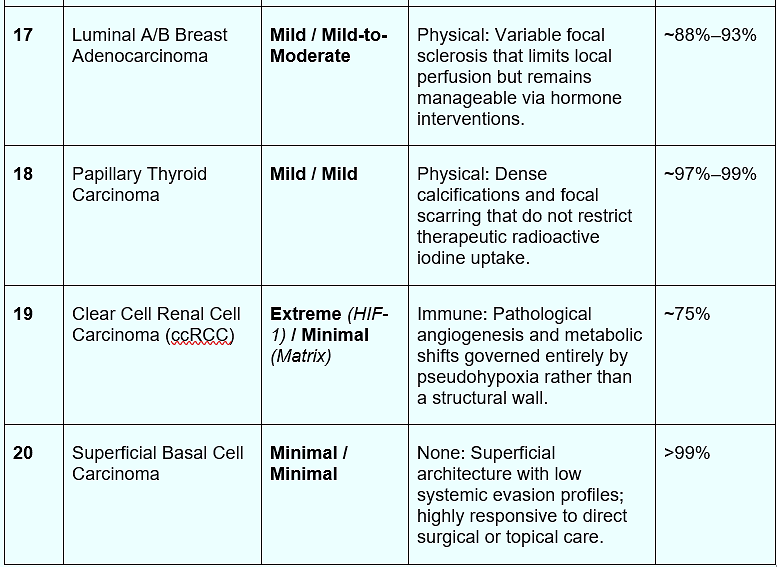
Core Biomechanical Analysis
· The Survival Inversion Curve: As individual tumor scores shift from Minimal/Minimal to Extreme/Extreme, 5-year survival rates plunge from nearly 99% down to less than 15%. This drop highlights that physical stroma and systemic hypoxia are not merely side-effects of growth, but are primary drivers of clinical lethality. [2, 4, 5, 6]
· The Mechanotransduction Feedback Loop: When desmoplasia increases local tissue stiffness, it compresses the tumor’s delicate blood vessels. This vascular collapse creates severe hypoxia, stabilizing hif-1 alpha. Once active, hif-1 alpha stimulates lysyl oxidase (LOX) expression, which crosslinks more collagen, makes the matrix even stiffer, and accelerates the cycle. [1, 3, 7]
· Immune Exclusion Dynamics: High combined severity scores reveal a distinct structural pattern under the microscope. Cytotoxic T-cells are often physically trapped within the outer fibrotic bands of the stroma, preventing them from penetrating into the tumor core to kill malignant cells.
When combined, these forces create a near-impenetrable barrier to modern medicine. As the density of this microenvironmental shield increases, patient survival plummets. In tumors with minimal physical stroma and no systemic hypoxia, like superficial basal cell carcinoma, the five-year survival rate is 99%. But in cancers displaying an “extreme” combination of both forces, such as Pancreatic Ductal Adenocarcinoma (PDAC) or Cholangiocarcinoma, the median five-year survival rate collapses to between 10% and 15%.
Understanding why this lethal combination occurs, and how we might theoretically use repurposed medications to dismantle it, is one of the most pressing frontiers in cancer research.
The Desmoplastic Shield: A Physical Barricade
To understand desmoplasia, imagine a wound that never stops healing. When a tumor grows, it damages the surrounding tissue. In response, the body sends in specialized repair cells called fibroblasts. In a healthy scenario, these cells lay down collagen—a tough, structural protein—to form a temporary scar over the injury, and then they leave.
However, cancer cells are master manipulators. They hijack these fibroblasts, transforming them into “cancer-associated fibroblasts” (CAFs). The tumor commands the CAFs to continuously produce vast amounts of collagen and a sticky substance called hyaluronan. Instead of a temporary scar, the fibroblasts weave a dense, rigid, fibrotic web throughout and entirely around the tumor. This is the desmoplastic shield.
This shield creates two devastating problems.
First, it acts as a mechanical barrier. Chemotherapy drugs travel through the bloodstream. When they reach a highly desmoplastic tumor, the dense collagen web physically prevents the large chemotherapy molecules from diffusing into the center of the mass.
Second, the shield traps the body’s immune system. Cytotoxic T-cells—the microscopic soldiers of the immune system designed to recognize and destroy cancer—are highly mobile. However, under a microscope, we routinely see these immune cells physically trapped in the outer fibrotic bands of the stroma, completely unable to penetrate the tumor core to kill the malignant cells inside.
Hypoxia: The Suffocation of the Microenvironment
As the desmoplastic shield grows thicker and stiffer, the immense mechanical pressure begins to compress the delicate, microscopic blood vessels that supply the tumor tissue. Over time, these local capillaries collapse entirely, cutting off blood perfusion.
Without blood, there is no oxygen. This creates a state of severe oxygen deprivation known as hypoxia.
Under normal circumstances, a lack of oxygen would cause cells to die. But cancer cells have evolved an extraordinary survival mechanism. When oxygen levels drop, the cancer cell stabilizes a specialized protein called Hypoxia-Inducible Factor 1-alpha (HIF-1α).
HIF-1α is the master switch for hypoxic survival. Once activated, it completely reprograms the cancer cell’s metabolism to survive without oxygen. More dangerously, HIF-1α signals the tumor to become more aggressive, promoting genetic instability, initiating metastasis (the spread to other organs), and altering the cell’s surface to become invisible to any immune cells that did manage to breach the physical shield.
Furthermore, hypoxia renders one of our most potent weapons—radiation therapy—largely ineffective. Radiation kills cancer cells by interacting with oxygen to create reactive oxygen species (free radicals) that shred the cancer’s DNA. Without oxygen present in the tissue, radiation simply passes through the tumor without causing lethal damage.
The Feedback Loop of Doom
The true tragedy of the solid tumor microenvironment is that desmoplasia and hypoxia are not isolated events; they feed off one another in a vicious cycle known as a mechanotransduction feedback loop.
It works like this:
The desmoplastic shield increases local tissue stiffness.
This stiffness collapses blood vessels, causing severe hypoxia.
Hypoxia stabilizes the HIF-1α protein.
HIF-1α stimulates the expression of an enzyme called Lysyl Oxidase (LOX).
LOX’s specific job is to heavily crosslink collagen fibers, making the desmoplastic matrix even stiffer, denser, and more rigid.
The increased stiffness collapses even more blood vessels, deepening the hypoxia, which produces more HIF-1α, which produces more LOX, which produces more stiffness.
This self-sustaining loop is why extreme desmoplastic cancers, such as PDAC and Desmoplastic Small Round Cell Tumors, are almost universally fatal once the loop is fully established. The tumor becomes an impenetrable, hypoxic rock that rejects drugs, deflects radiation, and physically traps the immune system.
Breaking the Shield: The Role of Repurposed Drugs and Supplements
Historically, oncology has focused almost entirely on finding toxic chemicals to poison the cancer cell itself. But if a tumor has a severe desmoplastic and hypoxic shield, the poison will simply never reach the target.
A growing paradigm in integrative and functional oncology involves attacking the shield rather than just the cell. The goal is to theoretically “normalize” the tumor microenvironment—breaking down the dense collagen and restoring normal blood flow (and oxygen)—so that traditional therapies and the immune system can do their jobs.
Researchers are investigating a variety of anti-fibrotic and anti-HIF strategies, many of which utilize repurposed drugs (medications already approved for other ailments) and specific nutritional supplements.
Anti-Fibrotic Approaches
To break the physical barrier, the goal is to stop the cancer-associated fibroblasts from producing collagen, or to break down the collagen that is already there.
Enzymatic Degradation: Modern medicine is actively testing agents like pegvorhyaluronidase alfa, an enzyme designed specifically to dissolve hyaluronan, the sticky “glue” in the desmoplastic shield, thereby reducing fluid pressure and allowing chemotherapy to enter the tumor.
Repurposed Blood Pressure Medications: Drugs like Losartan (an angiotensin II receptor blocker) have shown significant anti-fibrotic properties in preclinical models. By blocking specific growth factors (like TGF-β) that stimulate fibroblasts, Losartan can theoretically reduce collagen production and relax the stiff tumor matrix, reopening compressed blood vessels.
Natural Anti-Fibrotics: Supplements like Curcumin (the active compound in turmeric) and Sulforaphane (found in cruciferous vegetables) have demonstrated the ability to inhibit the TGF-β pathway in laboratory studies, potentially slowing the deposition of scar tissue around the tumor.
Anti-HIF Approaches
If we can block the HIF-1α protein, we can theoretically cut off the tumor’s ability to survive in a low-oxygen environment and halt the production of the LOX enzyme that stiffens the matrix.
Repurposed Anti-Parasitics and Anti-Diabetics: Medications like Mebendazole (an anti-parasitic) and Metformin (a ubiquitous diabetes drug) have gained massive attention in repurposed oncology. Metformin, for instance, alters cellular metabolism and reduces cellular oxygen consumption, which can theoretically lower the stabilization of HIF-1α.
Direct HIF Inhibitors: Certain small molecules and repurposed antimicrobials like Acriflavine have been shown in laboratory settings to bind directly to HIF-1α, preventing it from activating its survival and fibrotic pathways.
Natural HIF Suppressors: High-dose Vitamin C (particularly administered intravenously to bypass gut absorption limits) and specific polyphenols like Epigallocatechin gallate (EGCG, from green tea) act as powerful antioxidants that can promote the degradation of the HIF-1α protein before it can initiate the vicious feedback loop.
A Unified Future for Oncology
The Evasion Matrix of solid malignancies shows us a clear, undeniable truth: the physical structure of the tumor environment dictates the patient’s fate. We can no longer treat a highly desmoplastic, hypoxic tumor like Pancreatic Ductal Adenocarcinoma the same way we treat a highly vascularized, non-fibrotic tumor.
The combination of a dense fibrotic shield and an extremely hypoxic core represents a unified, biomechanical resistance mechanism.
By shifting our focus to dismantling the fortress—using a combination of traditional therapies alongside targeted anti-fibrotic and anti-HIF repurposed agents—we may finally find a way to breach the walls, restore vulnerability to the cancer cells, and fundamentally alter the grim survival statistics of the world’s most lethal solid tumors.
What combinations of repurposed drugs and supplements might you ask?
I recently covered this in my last article’s “Readers’ Questions & Answers” segment. Want to learn more about a specific type of cancer? I am currently evaluating specific cancers, and which cheap and readily available repurposed agents best target and suppress their desmoplastic shields and HIF-1 defenses. I welcome direction on this, and I especially value input from my readers.
Keep reading with a 7-day free trial
Subscribe to Repurposed Drugs: Powers & Possibilities to keep reading this post and get 7 days of free access to the full post archives.